Voigtlander 50 f1.0: Lèse-majesté and the Geometry of Light
Welcome back to the golden age: the battle of ultra-bright lenses.

Voigtlander 50 f/1.0 Leica M11
Starting in the 1960s, just as in the last 10 years, there has been a proliferation of ultra-fast lenses. Especially 50mm lenses, much to my delight (it’s my favorite focal length). The trend actually began in the 1950s with the first f/1.2 lenses available on the market.
A wide variety of lenses emerged in the 1960s and 1970s. To be precise, we can start in 1966, the year Leica introduced its exceptional and extremely expensive 50mm f/1.2 Noctilux, the forerunner of a series of legendary lenses. In this race, they all took turns: from Nikon with its extraordinary 58mm f/1.2 Noct Nikkor (in both Ai and Ai-S versions), to Canon, which patented its 50mm f/0.95 “The Dream Lens” in 1960 (the latter a rangefinder lens).
A surge similar to the one seen in the first two decades of the new millennium. In 2008, Leica unveiled the successor to the 50mm f/1 Noctilux, the astonishing 50mm f/0.95, which is still in production today. Nikon introduced an impressive 58mm f/0.95 Noct. A beast weighing nearly 2 kg, with a list price of over €8,000 and stunning optical performance. Canon didn’t sit idly by, introducing the updated 50mm and 85mm f/1.2 lenses for its new mirrorless mount. Sony also joined the race, unveiling a beautiful 50mm f/1.2 GM.
Alongside the big names, a number of small manufacturers have emerged with some truly intriguing products. Such as the Mitakon 50 f/0.95, the 7Artisan 50 f/1.1, and so on.
Amid all this, in this evolving landscape of optical research—driven by new tools and possibilities—Cosina-Voigtländer has emerged. It is one of the few companies that manufactures lenses using proprietary glass.
In recent years, the company has distinguished itself by producing lenses that are nothing short of exceptional. For example, on Sony cameras, the 50mm f/2 Apo Lanthar was one of the very few lenses capable of exceeding the resolution limits of the R4’s 61-megapixel sensor, even at full aperture. The 21mm f/1.4 has become the benchmark at that focal length, with exemplary aberration correction and incredible sharpness.
It’s only natural, then, to be curious about this new lens, which targets the high end of the market—not the low end—in terms of performance, but with a price in Italy of €1,750 (including VAT), which is highly competitive.
Unlike the Voigtlander 50mm f/1.2, it is significantly bulkier, but it is still effectively a “short” lens and sits well-balanced on the Leica M11. The large front diameter is inevitable.
Here are the specifications for the Voigtlander 50 f/1.0 Nokton.
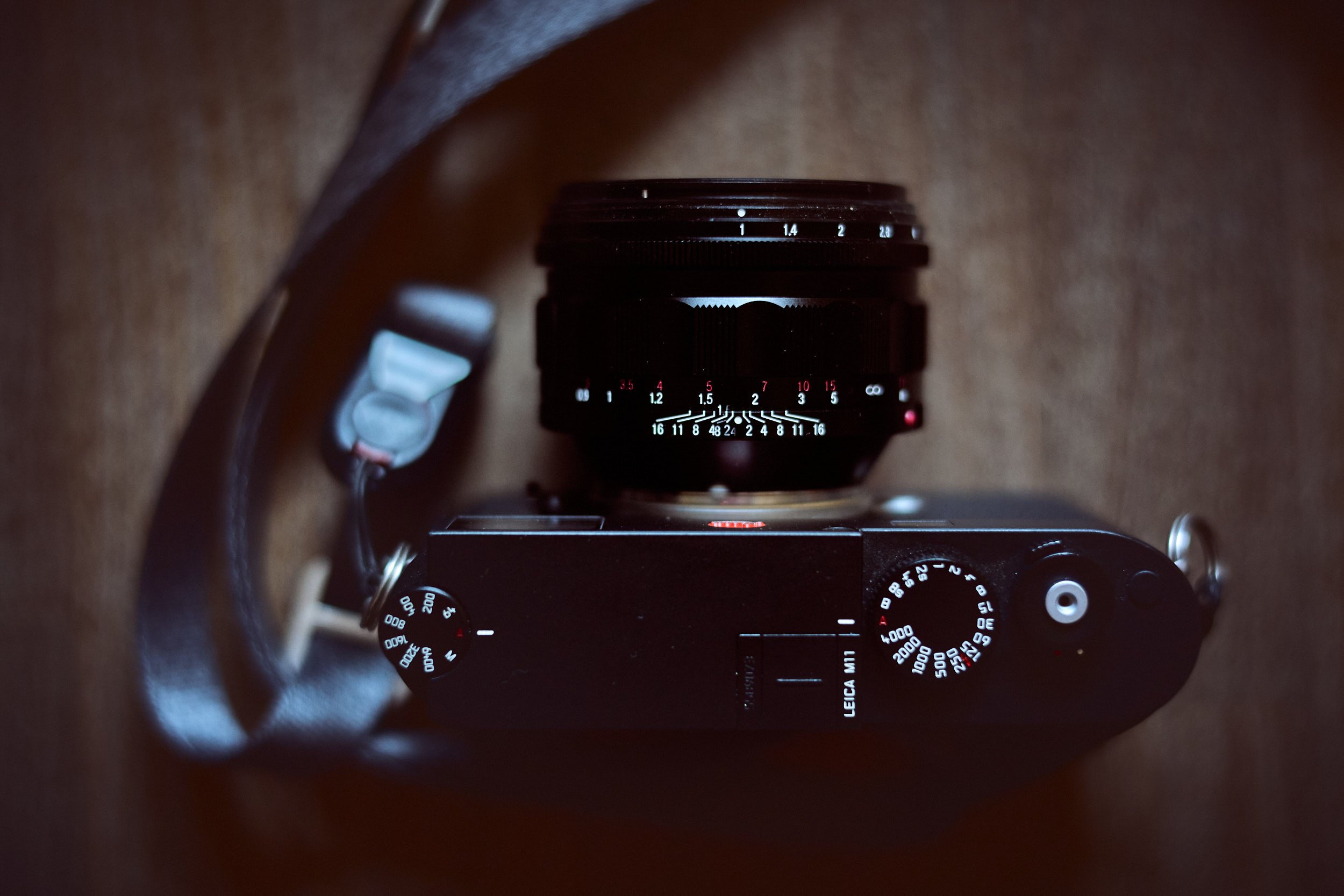
Voigtländer 50mm f/1.0 for Leica M11
Focal length: 50 mm
Maximum aperture: 1.0
Minimum aperture: 16
Optical configuration: 9 elements in 7 groups
Number of aperture blades: 12
Minimum focusing distance: 0.95 m
Diameter: 73.6 mm
Height: 55 mm
Weight: 484 g
Filter diameter: 62 mm
Lens mount: M-mount
—
So, all things considered, the size and weight are quite acceptable: in fact, it is the smallest and most compact ultra-fast lens for the Leica M, with the exception of the Voigtländer 50 f/1.2. However, the latter lacks certain key features. One detail not mentioned in the spec sheet is the presence of a floating element (in addition to the two aspherical elements, one of which is particularly sophisticated, complex, and expensive). This results in an almost perfect correction of residual spherical aberration even at short focusing distances. This is no small feat on a 50mm f/1.2 lens. On the aforementioned 50mm f/1.2, however, both the floating element and the high-quality aspherical element are absent. The result is a slightly more “dreamy” rendering at full aperture and at short focusing distances (within about 3 meters). This is why I decided to keep both; they are absolutely complementary in terms of rendering style.
Voigtlander 50 f/1.0. The desire for speed.
This seemingly reasonable question might be phrased this way… Why, in a world where digital cameras can handle extremely high ISO settings, would I need such an extreme, fast lens?
For aesthetic reasons. For the results you can achieve by playing with such shallow depths of field, especially considering that at full aperture, this marvel delivers results that are nothing short of incredible. One of the ideal fields for a 50mm f/1.0 lens could be portrait photography. But that’s not all.

Sofia, Voigtländer 50mm f/1.0, Leica SL2S

Sofia. Voigtländer 50 f/1.0. Leica SL2S.
A lens that’s truly sharp yet never harsh, with just the right amount of microcontrast for portraiture. And, in my opinion, it produces a soft yet distinctive, “descriptive” bokeh—not the generic bokeh found in so many modern lenses. On the Leica SL2S, moreover, it is possible to overcome even the lens’s only optical limitation—namely, the minimum focusing distance of 95 cm—using the 7Artisan Close Focus adapter, which, thanks to an internal helix, allows for a minimum focusing distance of around 40 cm. The level of sharpness is incredible, as is the three-dimensionality it delivers at f/1.0.

Pierpaolo. Voigtländer 50 f/1.0 Leica M11
You can see in full-screen view how the blur at the edges takes on a different character compared to the rest of the frame. This is essentially due to a certain amount of reverse field curvature—curiously, in the same direction as that found in the Leica 50mm f/0.95 Noctilux, though less pronounced here. In my humble opinion, this adds a certain character to the overall rendering of the image. The quality remains extremely high, and the correction of aberrations is remarkable considering we’re at f/1. In the portrait of Pierpaolo, the light was also quite harsh (ISO 64, 1/10,000 sec, f/1). However, some aberrations are still visible in such extreme conditions and at f/1.0—but only when zooming in to 100% magnification or beyond. An extraordinary result, on par with or superior to the best ultra-bright competitors. The Leica 50 f/0.95 shows only a slight hint of purple fringing (visible at 100% magnification or higher).
—

Pierpaolo. Voigtländer 50 f/1.0 Leica M11
The results are excellent in this second portrait of Pierpaolo as well. The colors are magnificent, despite the very challenging lighting conditions. Part of the credit goes to the Leica M11, Exposure X, and Capture One Pro 22.
Operations
From a practical standpoint, focusing at f/1.0 using the rangefinder isn’t exactly easy. The perfectly calibrated friction focus ring helps a bit, allowing for very precise, micrometric adjustments. The rotation angle isn’t excessive; in fact, it strikes the perfect balance between two seemingly incompatible factors: precision of movement and speed of operation.
Another thing about the Leica SL2S: its excellent electronic viewfinder makes it easy to focus in any situation. Unfortunately, I haven’t had a chance yet to try out the new add-on electronic viewfinder for the M11 (Visoflex).
The lens feels well-balanced on both cameras, though slightly better on the heavier SL2S. The lens hood comes standard with the lens, which is a great help in backlit situations (without it, you might get flare, which I think can actually be quite nice in certain situations) and protects the lens, since the front element is quite exposed. Not as pleasing as that of a Voigtlander 75 f/1.5 or 35 f/1.2 Mark 3. Or like a 35 Summilux Asph (not the FLE), but still pleasant.
The aperture ring clicks in 1/2-stop increments.
The depth-of-field scale on the lens barrel is quite accurate.

Wedding Photography
All the wedding photos were taken with a Leica M11.

An amazing 3D effect. Voigtlander 50 f/1.0

Indian wedding. Voigtlander 50 f1.0 Nokton


Destination Wedding at Rosciano Castle
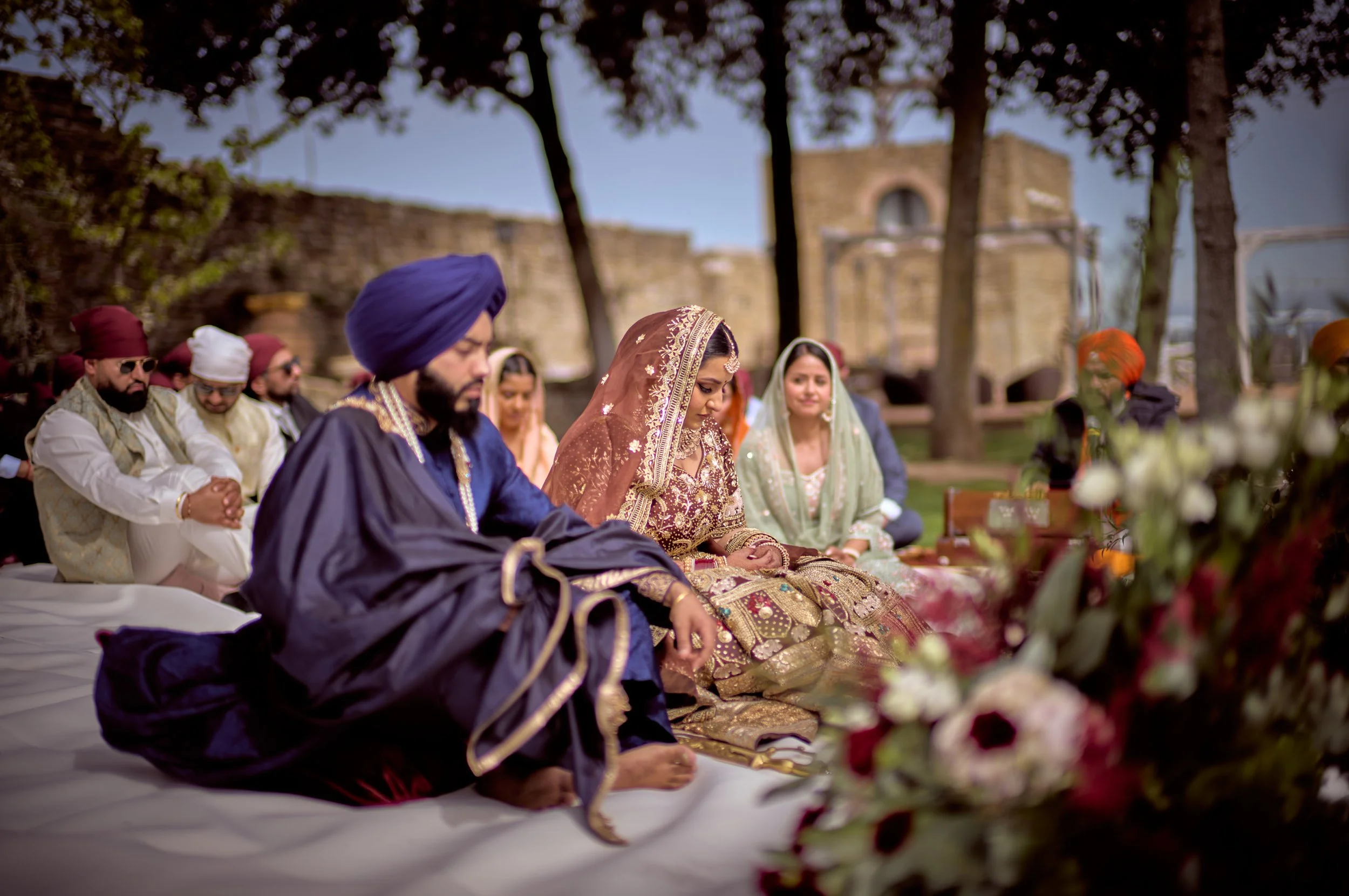
Voigtlander 50 f/1.0


Conclusions
The Voigtländer 50 f/1.0 manages to strike a rare balance of factors that are almost impossible to find all together. In terms of weight and size, it is by far the smallest and lightest f/1 or f/0.95 lens for full-frame cameras. It is also extremely compact in length, making it well-balanced even on a Leica M. It is significantly smaller and lighter not only than the Leica 50 f/0.95 but even than the older Leica 50 f/1.0.
Optically, it offers significantly higher contrast than both Leica lenses and unmatched sharpness at wide open. Compared to the Voigtlander 50mm f/1.2, it is considerably larger but also features a floating element in its optical design, which ensures uniform rendering with no residual spherical aberration even at the closest focusing distances. In my opinion, however, the slightly more “dreamy” look (though it remains extremely sharp) within 2 meters of the 50mm f/1.2 at full aperture is actually quite useful for certain types of images. Keep in mind the minimum focusing distance: 1 meter for the Leica Noctilux, 95 cm for the Voigtlander 50 f/1.0, and 70 cm for the Voigtlander 50 f/1.2. All three can get much closer with the 7Artiusan Close Focus adapter (highly recommended) on the Leica SL or a Voigtlander Close Focus adapter on Sony.
Always remember that if you love using your Leica or Voigtlander VM lenses on a Sony camera, you can have your sensor modified to optimize the performance of these superb lenses HERE.
In terms of aberrations, the lens is very well corrected. Aberrations are clearly visible at full aperture in harsh lighting conditions, but this is pretty much unavoidable. All competing lenses suffer from this as well. In such an extreme design, a little bit of aberration is unavoidable. The two Leica lenses we’re comparing suffer from it the most, but they’re also slightly better in terms of purple fringing (which stems from the interaction between the optics and the sensor). A truly minimal difference, in any case.
There’s a slight hint of reverse field curvature noticeable at the edges… (in my opinion, identical to the Leica 50mm f/0.95…) which can be an issue if you’re looking for maximum uniformity in rendering, but it’s not something you should reasonably expect at f/1.0. In fact, it lends a certain character to the images; especially in portraiture, it’s really interesting and makes the bokeh a bit less linear. Stopping down the aperture resolves this. Or by focusing beyond 2.5–3 meters.
It handles backlighting very well if you keep the lens hood on. You get some aesthetically pleasing flare when you remove it. I'm talking about extreme backlighting, with the sun in the frame.
The light falloff at the edges is quite noticeable, but it can be easily corrected in any RAW converter.
In short, it’s the best 50mm lens with extreme brightness currently on the market. And it’s priced at about one-eighth of what industry leaders charge. If that isn’t a bit of a shocker…

Advantages
Exemplary construction
Exceptional optical quality. The gold standard in its class.
Unbeatable value for money.
Compact size and weight, relative to its brightness and focal length.
The Leica M aims for minimal bulk.
Excellent performance even on the Leica SL2S.
Good performance in backlit conditions (with a lens hood).
A stunning rendering, full of character.
Soft, gradual, distinctive, and expressive bokeh.
The focus ring has a smooth, friction-free operation. The ring’s travel is also smooth.
Defects
Definitely bulkier than the extraordinary Voigtlander 50 f1.2
Minimum focusing distance of 95 cm (which is still the best in its class).
Some aberrations are visible at f/1 in very harsh lighting conditions (but this is inevitable; the competition performs even worse).
Focusing at f/1 on a rangefinder camera takes practice. It’s definitely easier on a mirrorless camera with an electronic viewfinder.
Reverse field curvature, visible at the edges, at f/1 and wide-open apertures (but it gives it a unique and very beautiful look).
Equipment: Leica M11, Leica SL2S
; Editing: Capture One 22 Pro, Exposure X
For workshops and training: click here or request information via WhatsApp or email.
I would like to thank Giorgio Bazzero, the Voigtlander importer in Italy, for providing me with this lens. You can purchase the entire range of Voigtlander lenses and accessories on his website.
