Sony A7R4 and Voigtlander Lenses: Field Test
On paper, it’s impressive. Here’s a quick rundown of the specs: 61 MP (9504 x 6336 pixels), 10 frames per second, a 240-MP high-resolution mode, dual high-speed UHS-2 SD card slots, redesigned menus with a better, simplified graphical interface, improved ergonomics and controls, a deeper grip, a 5.7-megapixel electronic viewfinder at 120 fps, a 567-point AF module with Real-Time Tracking and very extensive frame coverage, a buffer for over 60 photos when shooting in RAW + JPEG, ISO 100–32,000 with expansion from 50 to 102,000 ISO, 5.5-stop image stabilization, further improved colors compared to previous Sony models. On par with the best colors ever seen on a 35mm camera, the Leica M. Hats off. An extremely fast camera with very high resolution and image quality. Perhaps the highest among all 35mm cameras on the market today.

Sony A7 R4 + Voigtländer 50mm f/2 Apo Lanthar
With a camera featuring such a high-resolution sensor, the demands placed on the lenses are truly demanding. To take full advantage of this sensor’s incredible capabilities, I recommend using the best compatible lenses available on the market—whether they’re among the best Sony lenses or third-party options. Take these stunning Voigtlander lenses, for example, which are capable of exceeding the sensor’s resolution.
But lenses such as the Sony GM 135mm f/1.8, the Sony GM 24mm f/1.4, the Sony STF GM 100mm f/2.8, and the 90mm Macro are also capable of bringing out its enormous potential.

Voigtlander 21 mm f/1.4 Nokton (E-mount)

Sony A7 R4
The controls have improved significantly, starting with the tactile feedback of the dials and buttons, which now have a crisper click. The deeper grip and slightly taller body also contribute to this. Ideally, it would have been another 0.5 or 1 cm taller. However, it already feels very comfortable in the hand, and the improvement over previous models is noticeable. Only those with very large hands might still prefer an extra centimeter in height. The lock on the exposure compensation dial is also convenient, preventing accidental rotation, especially when using the camera attached to the trendy shoulder straps, such as Blackrapid.

Piazza Navona Sony A7R4 Voigtlander 50 f/2 Apo Lanthar
The dynamic range is amazing. Despite its 61 million pixels, the dynamic range is around 15 stops. Compared to the Sony A7R3, which I owned until recently, the performance is very similar despite having nearly 20 million more pixels. But it also has the ability to preserve colors in both shadows and highlights—a capability the R3 lacked.

Despite the compression, you can still see the incredible amount of detail in the shadows and highlights, as well as the beautiful gradation of tones. The sensor is truly magnificent. And with certain lenses, it really shines.
Surprisingly, the decision to opt for a sensor with a resolution that surpasses several medium-format cameras currently on the market has not resulted in significant compromises in image quality as ISO sensitivity increases. Of course, always remember that comparisons should be made at the same magnification to properly assess the signal-to-noise ratio and color quality.

Trevi Fountain – Sony A7R4, Voigtlander 21mm f/1.4 @ f/2.8, 1/125 sec, ISO 2000
As you can see, the color quality is nothing short of exemplary. The white balance performance in this challenging situation is also excellent.
Another huge step forward was the viewfinder. The upgrade from 3.6 MP to 5.7 MP is truly significant. This allows you to work with manual-focus lenses with a whole new level of speed and precision.

Sony A7R4 Voigtländer 50mm f/2 Apo Lanthar
Shooting with the Sony A7R4 in manual focus is truly fantastic. The focus peaking is finally precise enough, and the accuracy and image quality are high enough to allow for fast shooting. Of course, you sacrifice the R4’s excellent autofocus in exchange for top-notch optical performance, along with a more compact size and lighter weight (and lower cost…).
There’s not much to say about the autofocus. A 567-point system with nearly full-frame coverage. Since I still own the Sony A9 Mark 1, I can say that in terms of efficiency, they’re very close. The same goes for tracking performance. No discrepancy between the center and the edges. No issues with back or front focus. Even with the enormous additional challenges posed by a resolution that’s nearly triple. The module’s performance is virtually flawless. Whether using wide-angle or fast lenses. Whether in situations with extremely shallow depth of field, or with subjects rapidly moving away or toward the camera. An AF module perfectly suited for extremely dynamic photography. With Eye AF that’s essentially foolproof.
It’s worth noting that there’s an option that allows you to bypass the stop-down that occurs with some lenses; in low-light situations, when the aperture is closed down significantly (a rather unusual scenario), this can cause some issues. The approach is sound, but the lag needs to be addressed.

Piazza Navona Sony A7R4 Voigtländer 50mm f/2 Apo Lanthar
The image quality is simply exceptional. With the right lens, the dynamic range is infinite, and the gradation of colors or grayscale is extremely wide, malleable, and easy to work with. The sharpness and three-dimensionality are extraordinary. For me, having also used Fujifilm medium format cameras, this is the highest quality I’ve ever seen. Although medium format clearly retains an advantage when it comes to rendering depth. But we’re truly at levels that were unthinkable just a few years ago.
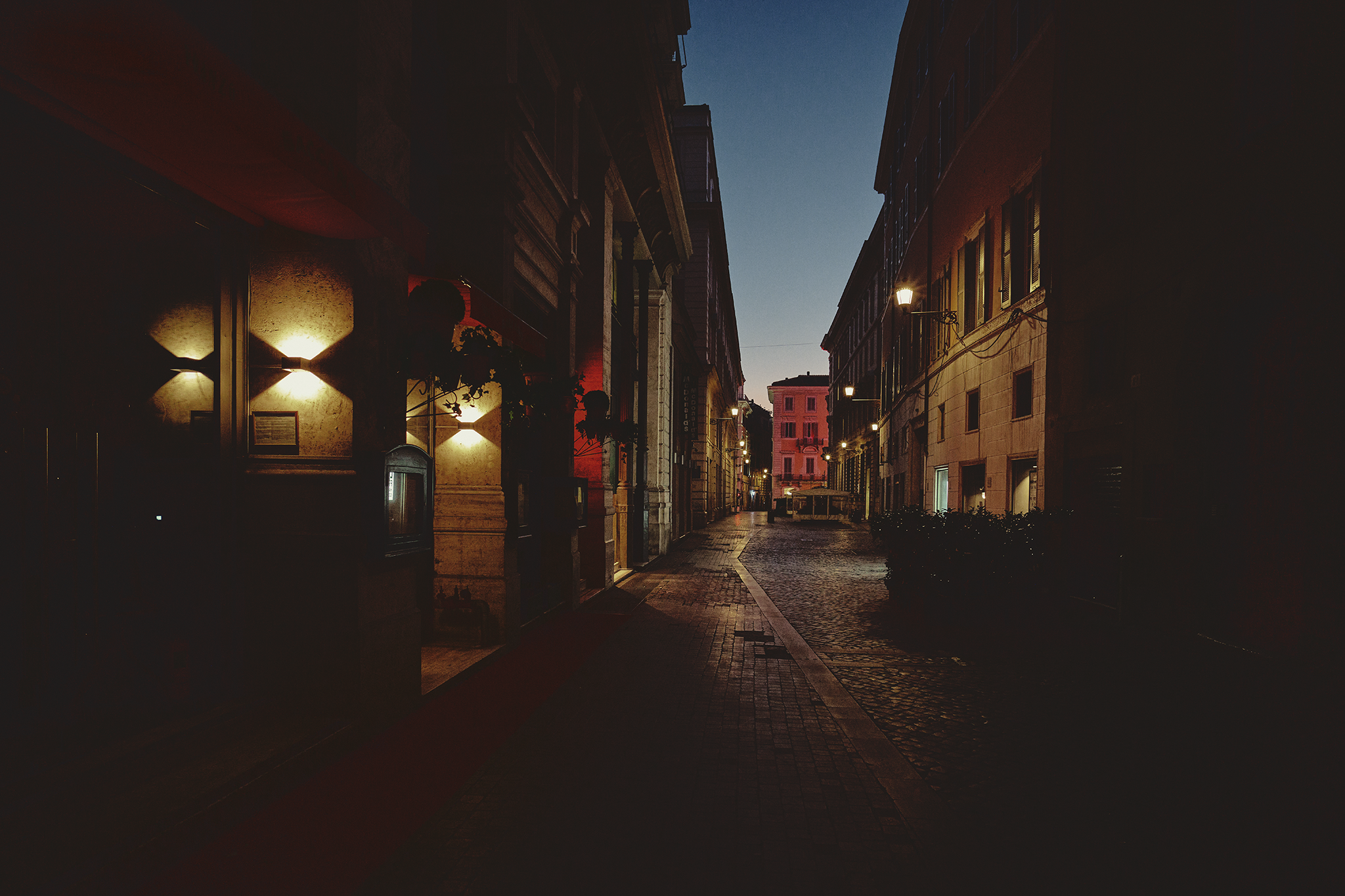
ISO 2000 — Voigtlander 21 f/2.8 1/125 sec
The color quality remains impressive even when we process files at high ISO settings and under less-than-ideal lighting conditions, such as those harsh sodium lamps.
Here is a summary of the strengths and weaknesses identified so far.
Advantages
Benchmark resolution, color quality, and dynamic range. It outperforms many medium-format cameras in several key areas.
AF with extensive customization options and extremely effective performance. Ideal for cameras used in dynamic photojournalism, nature photography, or sports photography. Adequate buffer capacity despite the inherent challenges of handling large files.
Excellent performance at high ISO settings. At the same magnification, it holds its own against the best in its class.
Significantly improved controls and ergonomics.
A huge, bright 5.7-megapixel viewfinder with an excellent refresh rate (120 fps) and highly accurate focus peaking.
Improved menus (but it's still not enough…).
Extremely effective image stabilizer (5.5 stops).
A more discreet, quiet, and responsive mechanical shutter. Excellent.
A sturdier and more refined design.
10 frames per second is sufficient for the vast majority of uses, even the most dynamic ones.
Dual high-speed UHS-2 SD card slots.
Excellent battery life (1,500 shots on a single charge without any major issues, despite the resolution of the sensor and viewfinder).
You can charge the device, even while working, via the mini USB port.
The user experience is vastly improved compared to other Sony models. It’s the most enjoyable, responsive, and fun to use.
Excellent video quality, with absolutely flawless autofocus.
26-megapixel APS-C sensor. It’s like having two cameras in one body.
Defects
4K limited to 8 bits.
Lack of lossless compressed RAW files (but this can be resolved using software like Dotphotons Raw).
Lack of an automatic switch for the first electronic curtain after a user-selectable time period.
The menus are still a bit too complicated.
Electronic shutter limited to 1/8000 of a second
It requires high-performance optics to harness its enormous potential.
The zoom control for the focus area (when using manual focus) could be slightly improved.
The touch screen could be improved in terms of its implementation.
Basically, given the huge disparity between its strengths and weaknesses—both in terms of quantity and significance—I think it’s clear just how much I love the Sony A7R4. Along with the revolutionary Sony A9, it’s undoubtedly the most successful Sony camera we’ve seen so far. It’s already a little gem.

Via Condotti Sony A7R4 Voigtlander 50 f/2 Apo Lanthar
The Voigtlander 50mm f/2 Apo Lanthar delivers exceptional results. With its outstanding combination of lightness, compactness, and top-notch optical performance, it truly does justice to the finest 35mm sensor currently available.

Eur - Voigtländer 50mm f/2 Apo Lanthar - Sony A7R4
The sensor’s incredible dynamic range, combined with the lens’s excellent performance in both shadows and highlights, provides a vast margin of error even in scenes with extremely high contrast and harsh lighting.
If, on the other hand, you prefer an AF lens with a similar level of performance, I recommend the Sony Zeiss Planar 50mm f/1.4. While only slightly inferior optically, it offers the significant advantage of being able to harness the enormous potential of the R4’s AF system. The trade-off is its bulkier size and significantly higher cost.

Sony A7R4, Voigtlander 50mm f/2 Apo Lanthar, ISO 8000, f/2, 1/125 sec

Sony A7R4 Voigtländer 50mm f/2 Apo Lanthar

Selfie – Sony A7R4, Zeiss Batis 40mm f/2
A selfie worthy of these… alienating times!
In conclusion… the machine’s capabilities are virtually endless. You can assign temporary functions to a single button as long as you hold it down, or even multiple functions simultaneously to a single customizable button (see Custom Assignment, Block 1, 2, or 3). You can truly build a machine tailored to your needs. And finally, this operational complexity becomes much easier to understand and use thanks to a graphical interface that simplifies things a bit. Once you’re done—which takes about a week to 10 days if you’re completely new to Sony—you’ll find yourself with a superb, lightning-fast camera, offering a level of quality never before seen in 35mm.
But above all, it’s much more enjoyable, fun, and comfortable to hold than before. It offers greater responsiveness and truly excellent tactile feedback, all complemented by one of the first truly fantastic electronic viewfinders. You won’t miss those highly acclaimed optical viewfinders.
While the Sony A9 remains the industry benchmark in terms of speed, responsiveness, and AF tracking performance, the Sony A7R4 comes very close to matching these capabilities, but with extraordinary image quality that handles 61 MP with ease. The new, ultra-smooth, and very quiet shutter, along with the further-refined image stabilization, make it easy to handle such a demanding resolution. Something that would be vastly more difficult with a mirror in the way.
If you're looking for cutting-edge technology and top-notch quality in the world of 35mm photography, with operating speeds that rival those of specialized cameras designed for sports and nature photography, look no further.
The new benchmark in its class is the Sony A7R4.
I would like to thank Fotoimport, the official Voigtländer importer in Italy, for lending me the lenses for testing.
And Sabatini Photography for the Sony A7R4, taken just before the lockdown.
Editing: Capture One 20 \ Exposure X5
