Poetry and the Gaze
THE POETICS OF THE GAZE
If we observe the world—or rather, the universe—by broadening our perspective as much as possible, we can see things from different angles and on multiple levels. If we were to arrive at a purely material level—without denying the soul or the construct of consciousness, which is infinitely more complex than any purely material mechanics, but simply remaining at the level of material analysis—we could reduce ourselves and our perspective to a part of the universe that reflects upon itself. We are stardust that reflects and observes the universe itself. A part of the universe, a tiny part that reflects upon itself.
A Kind of Magic: The Photographic Moment
In this paradox, we live and perceive existence as a constant flow of time, moving in one direction. We have countless ways to cheat time, but, once again, we remain on purely material ground. The only way to cheat time—at this level—is through photography. Tangibly, it is the only tool capable of freezing the moment in a single material unit: a photographic print, which can exist far beyond the existence of that tiny fraction of a second. Photography, precisely. A kind of magic.
That moment existed, and within that frame, it was captured forever. With a delicacy that words cannot describe, for the thickness of a negative is negligible, just like the fleeting nature of the photographic moment.
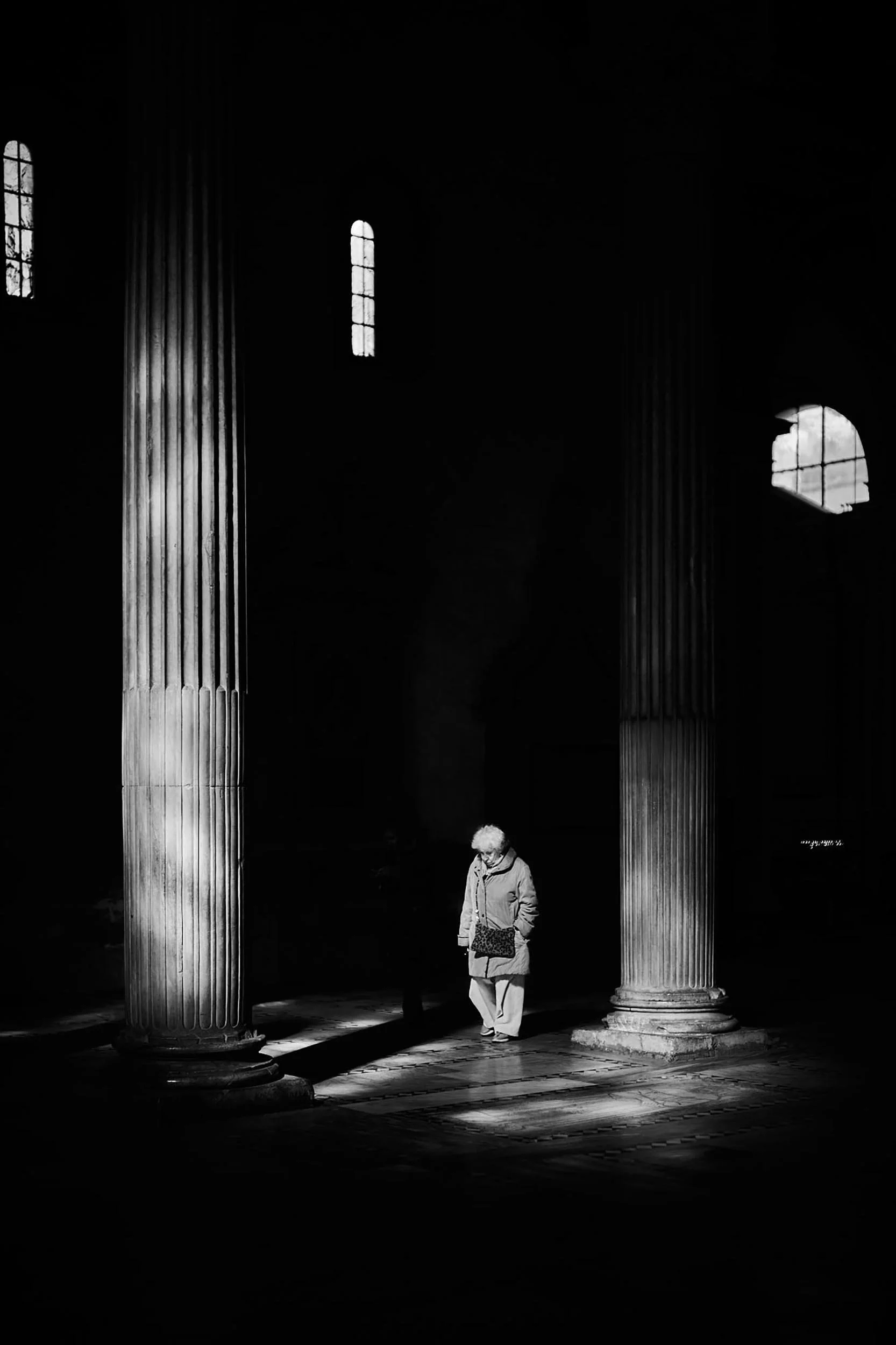


1/1000 of a second. 1 second. 4 hours. Exposure times. The duration of our existence.
We can choose any and all parameters to give structure to our frame. We can be highly skilled at making the most technically sound choices or at daring to make less conventional ones, or we can remain rigidly anchored to a precise formal structure. The key point is that what we choose should truly be the result of our experience, of who we truly are. Let’s ensure that a small trace of our existence is present in our photograph.

ISO sensitivity, our sensitivity.
Just as ISO sensitivity indicates how light-sensitive our sensor (or film) is, we should ensure that our frame includes another point of reference: our own sensitivity. This is just as variable as ISO sensitivity in digital photography. It depends on who we are, our cultural background, and the different stages of our lives. To develop our vision, it is essential that this be evident in our work.
The aperture. The focus of our gaze.
Our ability to interpret the world visually—to focus and direct our attention to certain elements within a given context while excluding others, and to bring order to what appears to be a chaotic and disordered whole—is extraordinary. Dorothea Lange explained that photography is the art that allows us to observe the world even when we don’t have a camera with us. And that’s a sentiment I deeply resonate with. Photography radically changes the way we see the world.
Finding Our Visual Aesthetic
By bringing all these elements together—our history, our present with all its emotional depth, our sensibilities, our interests, and so on—we can craft our own narrative of the world. Has everything already been captured on film? Absolutely true. But no two human beings have ever been exactly alike. We are all different, and in this sacred diversity, we must find our richness and absolute respect for one another. That is why there will never be two completely identical narratives, just as there will never be two identical human beings.
The dangers of digital technology, artificial intelligence, and social media
The dangers inherent in simplified access to certain tools, without an adequate supporting framework, are enormous. What remains of a photograph after it has been processed by an artificial intelligence program? Nothing, because without two fundamental elements—light and reality—it is no longer photography. Inevitably, our memory will be damaged, distorted, and warped. And I am referring to both family memory and collective, historical, and social memory. Are we sure that, for a little more convenience (yet again), it is worth paying such a high price?
The danger of social media, on the other hand, lies in oversimplification and conforming to passing trends. Here, too, the only remedy is to understand photography: its history, its works, and its creators. Be wary of the risks of oversimplification, conformity, and technology for technology’s sake. Dare to embrace limitations and inconveniences, and use technology only when it’s truly necessary.

All the photos on this site are available as limited-edition fine art prints. Whether you’re looking for a gift, office decor, or something for a law firm, etc., please contact us for more information, and don’t forget to sign up for our newsletter. You’ll find the sign-up form below.
