Photographic Portraiture: An Overview.
Beyond Street Photography — Portraiture

To discuss a genre that is completely different from what I usually do—namely, portrait photography, which I offer professionally—we need to take a step back and clarify a fundamental point: the existence of different photographic genres.
—-
Photographic genres – simplifications and categorizations.
As in any artistic field, the boundaries are blurred and often undefined. We humans need to organize and categorize in order to discuss things on a relatively simple level; but reality is never simple, and every simplification entails a loss.
One of the defining aspects of Street Photography (or at least a significant portion of it) is the so-called “decisive moment” of Bressonian memory. Well, this concept can be applied to any photographic genre: from portraiture to architectural photography, all the way to landscape photography.
For example, the unique light of a spring day filtering through the clouds can cast shadows and create patterns capable of transforming a landscape. That landscape, perhaps photographed thousands of times, may—who knows—never have been captured in that way. In my photography, and in the work of Studio Nove100, this is a founding principle, regardless of the genre.
Here is an example of a formal element that cuts across very different photographic genres. Even a portrait can be structured in an extremely dynamic way, in which the very expressive freedom of the subject—unconstrained by rigid poses—can make it possible to reach emotional and personal levels that would be precluded by a more formal approach. The “decisive moment” can also exist in portraiture.

Portraiture
Today, for the sake of brevity, we will focus exclusively on portraiture, but we will return to the topic by exploring other genres and intersections. When we think of a portrait, the levels of analysis are virtually endless, as are the ways of approaching it.
Personally, I have a very clear idea: I do not consider a photograph to be a portrait unless it is in some way representative of the person, at least in one aspect. The model’s pose, however believable, with technically perfect lighting, is not even the foundation of a portrait: it is merely an exercise in posing and lighting.
—-
Portrait or stylistic exercise?
It’s a fine line, and the same applies to self-portraits. If the pursuit is purely aesthetic, we fall into a trap; if the photographer’s ego takes precedence, we’ll see more of the photographer than the subject.
The balance is extremely delicate: it requires a dialogue and a relational timing composed of light and shadow, the right emotional distance. Whether it’s natural light, artificial light, flash, or continuous light, the timing changes: with flash, you have better control over the light, but the process slows down. In some sessions, extremely precise light management is required; in others, speed is essential to allow the subject’s emotions to emerge. There are no fixed rules, but remember that in portraiture there are at least five fundamental levels:
Aesthetics – Visual aesthetics
Formal – Technical and compositional choices. The formal structure of the photograph and its spaces.
Emotional – Feelings that are expressed to varying degrees of openness and intimacy.
Relational – A dialogue between the photographer and the subject, and between the subject and the portrait setting. Props included.
Existential – Deep meaning, identity
In no portrait will you find a perfect balance between these factors: one always takes precedence over the others. It depends on the photographer, the subject, and the reasons for having the portrait taken. If even one of these factors is completely missing, the portrait—as I understand it—doesn’t work.


The reason why people have their portraits taken
The “why” is the foundation upon which the balance between the five factors will be built.
It is clear that the result will differ for someone who poses to challenge themselves, compared to someone who does so to mark a moment of great change, for family photographs, for a “therapeutic” journey with their own image, or even for a professional portrait representing a new phase in their career. The motivations are endless and fundamental; without a meaningful dialogue with the photographer, one remains on the surface.
The Space and Time of the Portrait
Within the motivations of those requesting a portrait, the photographer must find a relational space in which to build a connection made up of light and shadow. In that moment, a stage — just like in the theater — where the subject is somewhat guided but also free to explore, interpret, let go, discover themselves, and lose themselves.
Portrait photography is not about “setting up two lights and making someone pose stiffly”: that would mean losing much of this wonderful art form. Take advantage of those moments of freedom when you say nothing to your subjects: often it is the silences, the imperfections, the pauses, the stray hair, or the unexpected shadow that reveal truly authentic expressiveness.


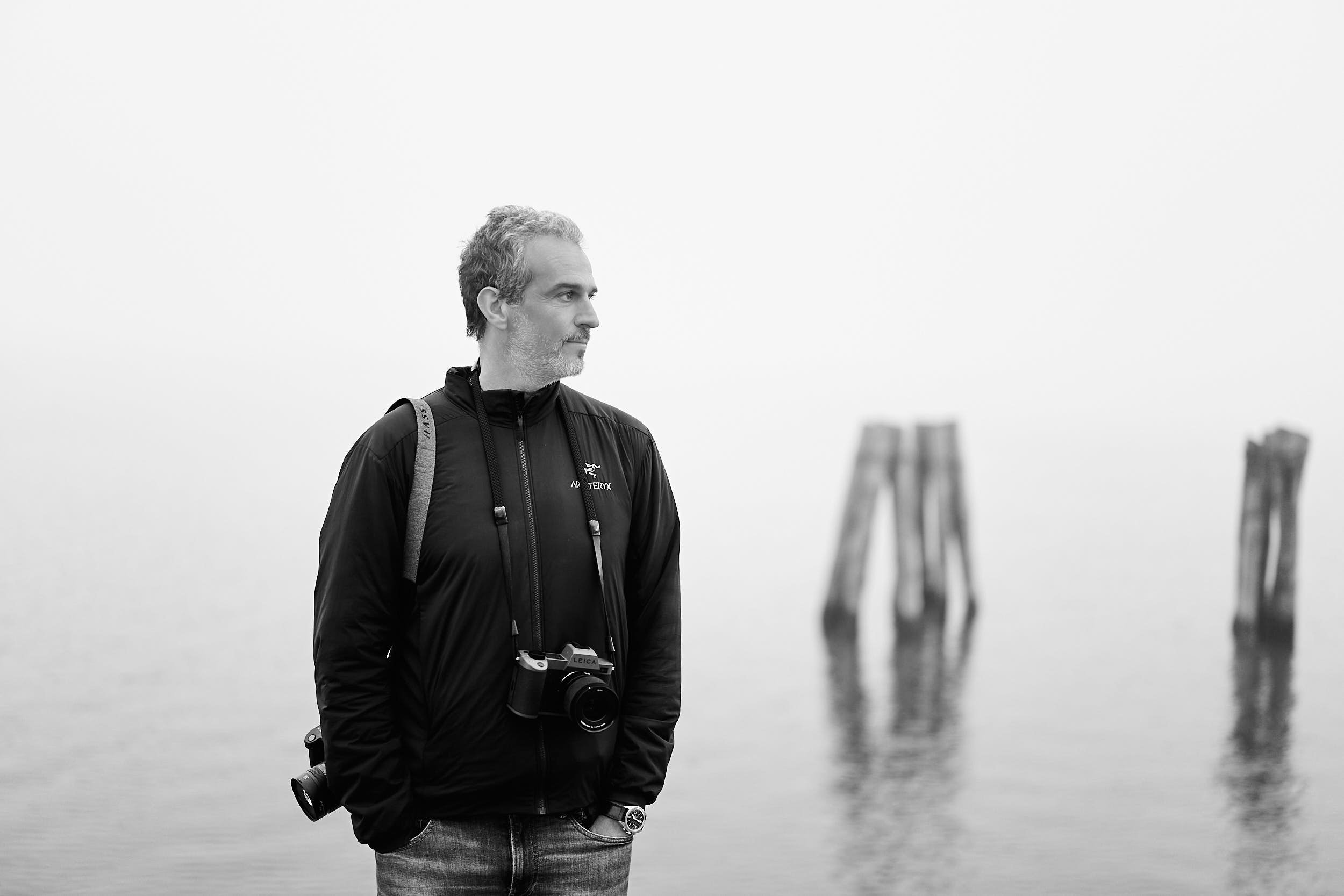

This philosophy is put into practice during the sessions at Studio Nove100
Don't forget to sign up for our newsletter!
