Voigtlander 35mm f/2 APO-Lanthar: Field Test and Optical Performance
Field Review of the 35 mm Apo Lanthar, Leica M Bayonet Mount
Voigtlander is back with its line of high-end lenses, the Apo Lanthar. The designation "APO" indicates a lens that is particularly well-corrected for chromatic aberrations. In fact, "Apo" stands for "apochromatic." This is further emphasized by the symbol of this splendid line of lenses: three colored lines arranged diagonally on the front of the lens itself.

Voigtländer 35mm f/2 Apo Lanthar \ Leica M10P
The lens isn’t tiny by Leica M standards, but it’s still very small by any other measure. The build quality is exemplary, with a focus ring that offers perfectly smooth resistance and an aperture ring with crisp clicks in 1/2-stop increments (the Sony E-mount version, as usual, features aperture clicks in 1/3-stop increments). The beautiful all-metal construction keeps the weight down to 304 grams.

Voigtländer 35 f/2 Apo Lanthar, Leica M1'0P

Voigtlander 35mm f/2 Apo Lanthar with Voigtlander lens hood

The Apo Lanthar series is distinguished by the three colored lines on the front, indicating exceptionally good correction of chromatic aberrations. Spoiler: that’s exactly the case.
Field test
Above all, as you know, I love testing gear in the field. I find that to be infinitely more representative than any lab test.
I tested the Voigtlander 35 Apo Lanthar on the Leica M, the Leica SL2-S, and the Sony A7R4. In every case, I found its performance to be truly remarkable—in fact, excellent.

Voigtlander 35 Apo Lanthar, Pincio, at sunset. Note the rendering of the highlights, the clarity in the shadows, and the subtlety of the tonal transitions. Taken here with a Leica M10P
I find the rendering of the highlights in this photo truly exemplary. It wasn’t the first photo I took, but it was one of the first where I said to myself, “Okay, this is a truly special lens.” There’s not a trace of aberration in the highlights or along the high-contrast edges. Excellent, to say the least.

This isn't the best photo, but the conditions were really challenging. It was 2 p.m., and the light was very harsh. Yet the bokeh is very soft, even against a jagged background like the foliage… still shot on the Leica M10P
Portrait Photography with the Voigtlander 35mm f/2 Apo Lanthar
There are many ways to use a 35mm lens for portraiture. I like to use it to set the scene a little for my subjects. And this 35mm lens has just the right subtlety, the right colors, and the three-dimensionality and tonal subtlety I look for in my portraiture. Plus, it’s a reasonable size, so placing it just a few centimeters away from the subject doesn’t make them feel overly intimidated.

Piazza Navona, Leica M10P, Voigtländer 35mm f/2 Apo Lanthar
Delicacy, a soft yet legible bokeh, sharpness… it has it all. The near-total absence of chromatic aberrations actually helps a great deal in black-and-white photography as well, ensuring a very high level of contrast while maintaining a remarkable delicacy in tonal transitions—which, when rendered in black and white, translates to a particularly rich and extensive grayscale.

Even at close focusing distances, the results are nothing short of exemplary.
The colors are crystal-clear, and the transition between in-focus and out-of-focus areas is sharp yet natural. In a nutshell: realistic and extremely pleasing. The minimum focusing distance of 50 cm is convenient. Image quality remains excellent at any aperture, from 50 cm to infinity. Essentially, with this lens, we adjust the aperture solely for depth of field, not for image quality.

Depth of field, three-dimensionality, delicacy, contrast, and tonal richness. Environmental portraiture is certainly an area where the Voigtlander 35mm lens shines.

Martha – Leica M10P, Voigtländer 35mm f/2 Apo Lanthar
Street Photography with the Voigtlander 35mm f/2 Apo Lanthar
The focus ring has excellent resistance, and the travel from 70 cm to infinity is just right—not too long to be sluggish, nor too short to lack precision. Furthermore, the depth-of-field scale is sufficiently precise, making it easy to work in hyperfocal distance. The viewfinder on the Leica M10P is also a huge help. The rangefinder’s accuracy in Leica’s latest model is simply impressive. The compact size of the camera body and lens goes a long way toward keeping things discreet and unobtrusive.


Leica M10P Voigtlander 35 f/2 Apo Lanthar - street photography, Rome, 2021

Leica SL2S with Voigtländer 35mm f/2 Apo Lanthar, Rome, 2021. Street Photography

Leica SL2S with Voigtländer 35mm f/2 Apo Lanthar, Rome 2021
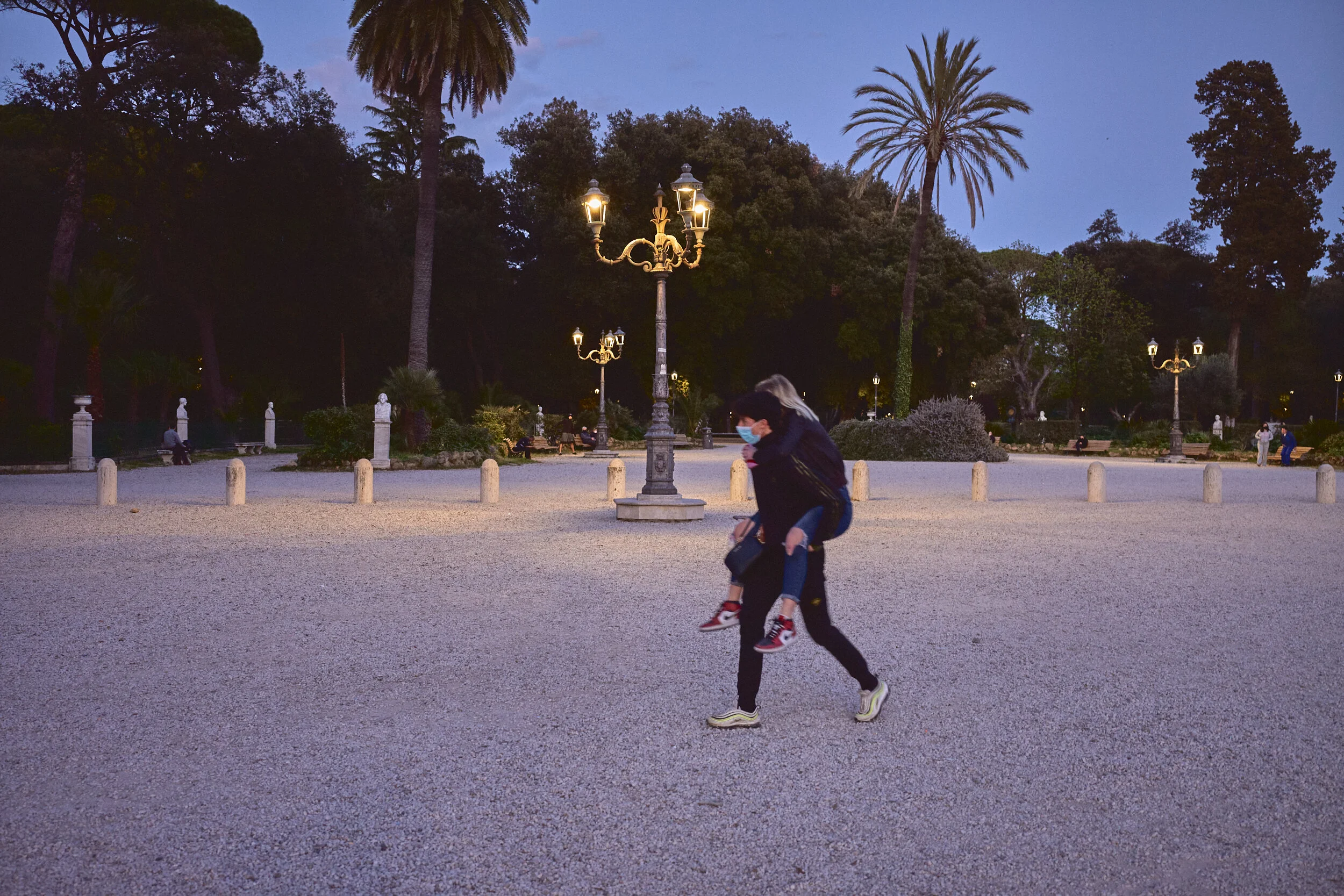
Leica M10P Voigtländer 50mm f/2 Apo Lanthar 3200 ISO

I love irony. Leica M10P, Voigtländer 35 f/2 Apo, Rome, 2021

Piazza del Popolo, Rome 2021. Leica M10P, Voigtländer 35mm f/2 Apo Lanthar
Conclusions
Essentially, the 35mm lens—especially on the Leica M—is truly an all-purpose lens. The 35mm f/2 Apo Lanthar has virtually no optical flaws. The image quality is superb at any aperture and far exceeds the resolving power of the Leica M10P’s 24-megapixel sensor (you can even see some moiré at the edges at f/2). The only flaw I’ve encountered is the possibility, when shooting against the sun with the sun in the frame and at an extremely specific angle (just a few degrees), of a red flare appearing. But this has only happened to me once, without a lens hood, and only at full aperture out of thousands of shots.


Eyes Wide Shut, Rome 2021. Leica M10P, Voigtländer 35mm f/2 Apo Lanthar

The remarkable performance of the 35mm f/2 Apo Lanthar in backlit conditions (Leica M10P)
PROS & CONS
Excellent quality, in every sense of the word.
Excellent value for money. Unbeatable.
Excellent construction.
Backlit rendering (except in very rare cases and at a very specific angle)
Exceptionally sharp.
Excellent ergonomics.
The subtlety of the tonal transitions.
Minimum focusing distance of 50 cm.
—————————————————————
Extremely rare instances of a red reflection in backlighting, without a lens hood at f/2
An optional and expensive lens hood.
ACKNOWLEDGMENTS AND INFORMATION
We would like to thank Fotoimport—the Italian importer of Voigtlander—specifically Giorgio Bazzero, for lending us the lens in question.
